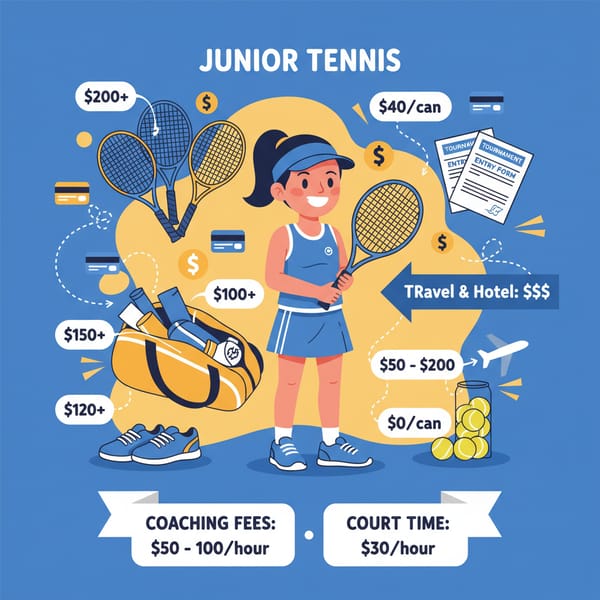
Junior tennis costs range from a few hundred dollars per year for recreational players to $30,000 or more for nationally competitive juniors. The actual amount depends on your child’s level, goals, and how deep into the competitive pathway you go.
Here’s a realistic breakdown of what junior tennis costs at every stage, so you can plan accordingly.
Quick Cost Summary by Level
| Level | Annual Cost Range |
|---|---|
| Recreational beginner | $500 - $2,000 |
| Local competitor | $2,000 - $6,000 |
| Sectional competitor | $6,000 - $15,000 |
| National competitor | $15,000 - $30,000+ |
| Elite/academy training | $30,000 - $75,000+ |
These ranges vary significantly by region. Tennis is generally more expensive in major metropolitan areas and less expensive in smaller markets.
Tennis Lesson and Coaching Costs
Coaching is typically the largest expense in junior tennis. Costs vary based on coach credentials, lesson format, and location.
Group Lessons
Group lessons are the most affordable way to learn tennis. Parks and recreation programs, club group clinics, and academy group sessions all fall into this category.
| Lesson Type | Cost per Hour | Annual Cost (2x/week) |
|---|---|---|
| Parks & rec programs | $10 - $25 | $1,000 - $2,500 |
| Club group clinics | $25 - $50 | $2,500 - $5,000 |
| Academy group training | $40 - $75 | $4,000 - $7,500 |
Group lessons work well for beginners and intermediate players. Your child gets instruction, hitting partners, and social interaction at a reasonable price.
Private Lessons
Private lessons become more common as players advance and need individualized attention.
| Coach Level | Cost per Hour |
|---|---|
| High school/college player | $30 - $50 |
| Club teaching pro | $60 - $100 |
| Experienced touring pro | $100 - $150 |
| High-performance coach | $150 - $250+ |
Most competitive juniors take 1-3 private lessons per week in addition to group training. At $80/hour for a solid club pro, two weekly privates runs about $8,000 per year.
Full-Time Academy Training
Tennis academies offer intensive training programs that can replace traditional schooling.
| Program Type | Annual Cost |
|---|---|
| Part-time academy (after school) | $8,000 - $15,000 |
| Full-time day student | $20,000 - $40,000 |
| Full-time boarding student | $40,000 - $75,000 |
Academy costs vary dramatically. IMG Academy and similar elite programs charge premium rates, while regional academies may offer comparable training at lower prices.
Tournament Costs
Tournament expenses include entry fees, travel, lodging, and food. These costs escalate quickly as players compete at higher levels.
Entry Fees
| Tournament Level | Entry Fee |
|---|---|
| Local club tournament | $25 - $50 |
| USTA local/district | $35 - $60 |
| USTA sectional | $50 - $85 |
| USTA national | $75 - $125 |
| ITF junior events | $50 - $100 |
A player competing in 15-20 tournaments per year spends $750 - $2,000 just on entry fees.
Travel Costs
Travel is where tournament expenses really add up. Local tournaments require minimal travel, but sectional and national events often mean flights, hotels, and rental cars.
| Tournament Type | Typical Travel Cost |
|---|---|
| Local (within 1 hour) | $20 - $50 |
| Regional (2-4 hours) | $100 - $300 |
| Sectional (flight required) | $500 - $1,500 |
| National | $1,000 - $3,000 |
A sectionally competitive player might attend 4-6 events requiring flights annually, adding $3,000 - $9,000 in travel costs. National competitors travel even more frequently.
Reducing Tournament Costs
Parents find creative ways to reduce tournament expenses:
- Carpooling with other tennis families to regional events
- Hosting players from other areas in exchange for reciprocal hosting
- Booking early for better flight and hotel rates
- Staying with family or friends near tournament venues
- Focusing on regional events until rankings require national travel
Equipment Costs
Tennis equipment costs are modest compared to coaching and tournaments, but they add up over time.
Racquets
| Item | Cost | Replacement Frequency |
|---|---|---|
| Junior racquet (beginner) | $30 - $50 | As child grows |
| Junior racquet (intermediate) | $80 - $150 | As child grows |
| Adult racquet (competitive) | $150 - $250 | 1-2 years |
| Backup racquet | $150 - $250 | As needed |
Competitive players should have at least two identical racquets in case of string breakage during matches.
Strings and Stringing
| Item | Cost | Frequency |
|---|---|---|
| Stringing labor | $15 - $30 | Every 1-3 months |
| Synthetic gut strings | $8 - $15 | Every 1-3 months |
| Polyester strings | $10 - $25 | Every 1-3 months |
Active tournament players may need restringing monthly. At $35-50 per restring, that’s $400-600 annually just for strings.
Shoes
Tennis shoes wear out faster than you’d expect, especially for players training multiple times per week.
| Level | Shoe Cost | Pairs per Year |
|---|---|---|
| Recreational | $50 - $80 | 1 |
| Competitive | $80 - $150 | 2-4 |
| Intensive training | $100 - $150 | 4-6 |
Budget $200-600 annually for shoes depending on training intensity.
Other Equipment
| Item | Cost | Notes |
|---|---|---|
| Tennis bag | $50 - $150 | Lasts 2-3 years |
| Clothing | $200 - $500/year | More for tournament players |
| Overgrips | $20 - $50/year | Replace every few weeks |
| Dampeners | $5 - $15 | Optional, last a while |
USTA Membership and Fees
Playing USTA tournaments requires membership.
| Membership | Annual Cost |
|---|---|
| USTA Junior membership | $20 |
| USTA Junior + Adult | $44 |
| Safe Play certification (required) | $0 (included) |
Some sections or districts have additional fees for tournament players, typically $25-75 per year.
Hidden Costs Parents Forget
Beyond the obvious expenses, several costs catch parents off guard:
Court Time
If your child practices outside of structured lessons, you may need to rent court time.
- Public courts: Often free
- Club courts: $20-40/hour
- Indoor courts: $30-60/hour
Winter months in cold climates require indoor court time, significantly increasing costs.
Ball Machine Rental
Some facilities charge for ball machine use: $10-25/hour.
Fitness Training
Competitive juniors often add fitness training to their schedule.
- Group fitness classes: $100-200/month
- Personal training: $50-100/session
Sports Psychology and Mental Coaching
Higher-level players sometimes work with sports psychologists: $100-200/session.
Video Analysis
Some coaches charge extra for video analysis sessions: $50-150/session.
Sample Annual Budgets
Here’s what a typical year looks like at different competitive levels.
Recreational Player (Ages 6-10)
| Expense | Annual Cost |
|---|---|
| Group lessons (2x/week) | $2,000 |
| Equipment | $200 |
| Club tournaments (4-6) | $200 |
| Total | $2,400 |
Local Competitor (Ages 10-14)
| Expense | Annual Cost |
|---|---|
| Group training (3x/week) | $4,000 |
| Private lessons (1x/week) | $4,000 |
| Equipment | $500 |
| Local tournaments (12-15) | $600 |
| Regional travel | $1,000 |
| USTA membership | $44 |
| Total | $10,144 |
Sectional Competitor (Ages 12-16)
| Expense | Annual Cost |
|---|---|
| Academy/intensive training | $8,000 |
| Private lessons (2x/week) | $8,000 |
| Equipment | $800 |
| Tournament fees (20+) | $1,500 |
| Travel (regional + sectional) | $5,000 |
| USTA membership | $44 |
| Fitness training | $1,500 |
| Total | $24,844 |
National Competitor (Ages 14-18)
| Expense | Annual Cost |
|---|---|
| Academy training or high-level coaching | $15,000 |
| Private lessons | $10,000 |
| Equipment | $1,200 |
| Tournament fees (25+) | $2,500 |
| National travel | $15,000 |
| USTA membership | $44 |
| Fitness and support staff | $3,000 |
| Total | $46,744 |
How to Manage Junior Tennis Costs
Start Slow
Don’t invest heavily until you know your child loves tennis and wants to compete. Begin with affordable group lessons and local tournaments. Increase investment as interest and results grow.
Prioritize Coaching Over Tournaments
Quality coaching develops skills. Tournaments test them. If budget is tight, invest more in coaching and play fewer tournaments. Skills compound; tournament results at young ages don’t.
Consider Value Over Price
The most expensive coach isn’t always the best fit. Look for coaches who connect with your child, communicate well, and have a track record of player development.
Explore Scholarship Opportunities
Many academies and programs offer partial scholarships for talented players who can’t afford full tuition. Ask about financial assistance—it’s more common than you’d think.
Build a Tennis Community
Connect with other tennis families. Share travel costs, exchange hosting, and share equipment your child has outgrown. The tennis parent community is generally supportive.
Keep Perspective
Junior tennis is expensive, but it’s an investment in your child’s development—not just as a player but as a person. The lessons in discipline, resilience, and competition have value beyond the court.
That said, don’t go into debt for tennis. Set a budget you can sustain long-term and make decisions within those constraints.
Is Junior Tennis Worth the Cost?
This depends on your goals.
If you’re hoping tennis pays for college, understand that full athletic scholarships in tennis are rare and intensely competitive. Partial scholarships are more common but still require high-level results.
If you value the life lessons, physical fitness, social connections, and personal development tennis provides, the investment can be worthwhile at any competitive level.
The key is matching your investment to realistic expectations. A recreational player can have a wonderful tennis experience for $2,000-3,000 per year. You don’t need to spend $30,000 annually unless your child has genuine aspirations—and results—at the national level.
Conclusion
Junior tennis costs range from modest recreational expenses to significant investments for nationally competitive players. Understanding these costs helps you plan appropriately and avoid financial strain.
Start with affordable options, increase investment as your child’s commitment grows, and always keep the experience in perspective. Tennis provides valuable skills and experiences regardless of how much you spend—but only if the investment is sustainable for your family.
The best tennis investment is one that keeps your child playing, improving, and enjoying the sport for years to come.